
Biography of Rev. Joseph Thomas Dorsey

SPRINGFIELD COMMUNITY ARCHIVE
Rev. Joseph Thomas Dorsey
(1877–1949)
Minister · Educator · Community Builder
"A life of faith, service, and resilience in the heart of Georgia"
A Heritage Biography prepared by the Springfield Community Center, Inc. · Union Point, Georgia
Biographical Overview
The Reverend Joseph Thomas Dorsey was a Black minister, educator, and community builder whose life spanned one of the most consequential periods in American history — from the aftermath of Reconstruction through the depths of the Jim Crow era. Born on October 27, 1877, in Warren County, Georgia, Rev. Dorsey came of age in a rural landscape where formerly enslaved families and their descendants were forging new lives under extraordinary hardship. He answered a call to ministry that placed him at the very center of African American community life, where the church served not only as a house of worship but as a schoolhouse, a meeting hall, and a fortress of dignity. His story, preserved in part through a remarkable 1916 biographical interview, stands as a testament to the strength and vision of the men and women who built the Springfield community and the broader network of Black institutions across central Georgia.
Born | October 27, 1877 — Warren County, Georgia |
Died | March 30, 1949 (aged 71) — Atlanta, Fulton County, Georgia |
Burial | Lincoln Cemetery, Atlanta, Georgia |
Life Timeline
The following timeline traces the arc of Rev. Dorsey's life from birth through his decades of ministry and service. Where specific dates are documented, they are noted; where the historical record is less precise, events are placed within the broader context of his era.
1877central Georgiacentral Georgia | Born in Warren County, Georgia. Joseph Thomas Dorsey entered the world twelve years after the close of the Civil War, in a county where Black families were building new lives on the land they had once been forced to work in bondage. |
1880s | Childhood in post-Reconstruction Georgia. Young Joseph grew up during a period of rapid change and rising oppression. The gains of Reconstruction were being rolled back across the South, and Black communities in rural Georgia turned inward — building their own churches, schools, and mutual aid networks to sustain themselves. |
1890s | Education and the call to ministry. Atlanta Baptist College (1897–1913) — successor to the Augusta Institute and forerunner of Morehouse College — prepared African American men for ministry and teaching during the segregation era. Closely associated with Friendship Baptist Church in Atlanta, pastored by Rev. Edward Randolph Carter, the college drew young men like Dorsey who felt the call to preach and sought formal theological training through Georgia's Baptist institutional network. |
1890s– 1900s | Early ministry career. Rev. Dorsey began his work as a minister during the height of Jim Crow, when the Black church was the most important institution in African American life — organizing education, providing welfare, settling disputes, and sustaining hope. He served churches across the central Georgia region. |
1900s– 1910s | Community leadership and educational contributions. Beyond the pulpit, Rev. Dorsey served as a leader in the broader community — contributing to the educational and civic life of Black families in the Springfield area and surrounding counties. Ministers of his generation were often the most educated men in their communities, and they carried responsibilities far beyond Sunday sermons. |
1916 | Biographical interview with J.P. Stone. In a rare and significant act of self-documentation, Rev. Dorsey sat for a detailed biographical interview recorded by J.P. Stone. This interview — given during the height of the Jim Crow era — preserved his life story in his own words, an extraordinary record at a time when the voices of Black Georgians were systematically excluded from the public record. |
1920s– 1940s | Continued ministry and elder leadership. Rev. Dorsey continued serving his community through the Great Migration, the Great Depression, and the early years of the Second World War — a period that reshaped Black life across the South. He remained a pillar of faith and stability for his congregation and community. |
1949 | Passed away in Atlanta, Georgia. Rev. Joseph Thomas Dorsey died on March 30, 1949, at the age of 71. He was laid to rest at Lincoln Cemetery in Atlanta — a historic African American cemetery established in the 1920s that serves as the final resting place for more than 200,000 people, including civil rights leaders, educators, and community builders. |
In His Own Words — The 1916 Interview
In 1916, at the age of thirty-eight, Rev. Joseph Thomas Dorsey gave a detailed biographical interview to J.P. Stone. This interview is a document of remarkable significance — not only for what it tells us about Rev. Dorsey's life, but for the very fact of its existence.
During the Jim Crow era, the voices of Black Americans in the rural South were systematically silenced, excluded, and erased from the public record. Census takers often misspelled names or omitted families entirely. Newspapers ignored Black achievements. Courts denied Black testimony. In this context, the act of sitting down to tell one's own story — to have it recorded and preserved — was both rare and radical. It was an assertion of personhood, of history, of a life that mattered and deserved to be remembered.
Rev. Dorsey's interview provides a window into the lived experience of a Black minister in early twentieth-century Georgia. It captures not only the facts of his biography — birth, education, ministry, family — but the texture of a life shaped by faith, hard work, and an unwavering commitment to his community. His words carry the cadence and conviction of a man who understood the power of testimony.
A modernized version of the 1916 interview text has been prepared by the Springfield Community Center to make Rev. Dorsey's language accessible to today's readers — while preserving his voice, his dignity, and the full meaning of his words. |
I was born in 1877 in Warren County, Georgia, on the plantation of Mr. M.M. Cody, about a mile and a half from Brier Creek and five miles from Warrenton, along the highway between Atlanta and Augusta. My parents, born before the Civil War, were enslaved by Mr. Cody, known locally as “Master Cody.” They still live on that same land and are the proud parents of sixteen children. I am the seventh. Until I turned twenty-one, I worked beside my family as a laborer. People said I was one of the best. I spent four years working for Mr. Cody, two for Tom Keepler, and two for Seab Williford. My schooling was limited because I worked during the day to help support my parents and siblings. My Christian life began in September 1892, when I was converted under the preaching of Rev. A. Pate at Cody Grove Baptist Church in Warren County. I became active in Sunday School and served faithfully as superintendent. During those years, I felt a growing call to the ministry. In 1898, I could no longer ignore that call. I applied for a license to preach, passed my examination, and entered the gospel ministry. That same year, I married Miss Miranda Thurman and moved to Athens, Georgia, where I joined Ebenezer Baptist Church under watchcare. Opportunities to preach were few, but I kept praying, working hard by day, and studying at night. My wife’s illness made those years difficult, yet I remained steadfast. In 1901, I accepted the pastorate of New Town Baptist Church in Athens, which had only thirty-three members and a heavy debt. That same year, I was ordained at Cody Grove Baptist Church and returned to Athens with renewed purpose. Within a year, many souls were added to the church, much of the debt was paid, and we rebuilt the sanctuary. The congregation renamed it Dorsey Tabernacle. My next calls were to New Bethel Baptist Church in Madison County, Chestnut Grove Baptist Church in Clarke County, and Mount Zion Baptist Church in Elbert County. After six years at Bethel, I accepted the pastorate of Thankful Baptist Church in Hutchens, Oglethorpe County. In 1910, I entered the Divinity program at Atlanta Baptist College, and I continued through the 1911–1912 term as a first-year student. My regular preaching schedule is: First Sunday at Chestnut Grove, Athens, GA; Second Sunday at Thankful Baptist, Hutchens, GA; Third Sunday at Dorsey Tabernacle, Athens, GA; and Fourth Sunday at Springfield Baptist, Crawfordville, GA. — Rev. Joseph Thomas Dorsey, as told to J.P. Stone, 1916 |
Why This Record Matters
First-person testimony from Black Americans in the Jim Crow South is among the rarest and most precious of historical sources. Oral histories, biographical interviews, and personal narratives like Rev. Dorsey's provide what no census record or property deed can: the inner life, tmotivations,faith, and humanity of the people who built communities like Springfield. When we preserve and share these voices, we resist the erasure that Jim Crow intended. We ensure that the men and women who built our institutions are known not only by the facts of their lives, but by the stories they chose to tell about themselves.
Historical Context
Post-Reconstruction Georgia and the Rise of Jim Crow
Rev. Dorsey was born in 1877 — the year that marked the formal end of Reconstruction, when federal troops withdrew from the South and the protections afforded to formerly enslaved people began to collapse. In Georgia, the decades that followed saw the systematic dismantling of Black political power through poll taxes, literacy tests, the white primary, and the ever-present threat of racial violence. By the 1890s, Jim Crow laws had hardened into a rigid caste system that would persist for more than half a century. Black Georgians were denied access to public education, excluded from the political process, and subjected to an economic order designed to keep them dependent and disenfranchised. In 1900, the average Black school in Georgia had one teacher for every ninety-three students, and per-capita spending on Black education was a fraction of what was spent on white schools. It was within this landscape of deliberate deprivation that Rev. Dorsey and his generation built the institutions that sustained their communities.
The Black Church as the Heart of Community Life
In the absence of state support, the Black church became the single most important institution in African American life across the rural South. It was far more than a place of worship. The church served as a school, a courthouse, a bank, a social welfare agency, and a training ground for leadership. Ministers like Rev. Dorsey were often the most educated and respected figures in their communities — called upon to settle disputes, advocate for families in crisis, organize mutual aid, and represent their people to the outside world. The church was where children learned to read, where families gathered for fellowship, and where communities found the spiritual strength to endure. In the Springfield community and across central Georgia, the church was the foundation upon which everything else was built.
Training a Generation: Augusta Institute and the Baptist Network
The education of Black ministers in Georgia was made possible by a network of Baptist institutions whose influence extended across the state. The Augusta Institute, founded in 1867 in the basement of Springfield Baptist Church in Augusta, Georgia — the oldest independent African American church in the United States — was established by Rev. William Jefferson White with the support of Rev. Richard C. Coulter, a former slave, and Rev. Edmund Turney of the National Theological Institute. The school was created to prepare Black men for careers in ministry and teaching. In 1879, the institution moved to Atlanta and became the Atlanta Baptist Seminary; by 1897, it had been authorized to grant degrees and was renamed Atlanta Baptist College. The college was closely associated with Friendship Baptist Church, pastored for over sixty years by Rev. Edward Randolph Carter, a prominent African American Baptist minister and educator whose leadership helped shape the college's mission and deepen its ties to the community it served. Rev. Dorsey's enrollment in the Divinity program has been confirmed through the surviving 1911–1912 Catalogue of Atlanta Baptist College — a primary source document now publicly available through the Digital Public Library of America and HathiTrust. His name, along with those of family members, appears in the catalogue, providing direct archival verification of his theological training. The college closed in 1913, just after Rev. Dorsey's time there, but its legacy continued through Morehouse College — one of the most storied institutions in American history. The college's archives, including Rev. Carter's papers, are preserved at the Auburn Avenue Research Library on African American Culture and History in Atlanta. This network of Baptist training shaped the ministers who served rural Georgia, and its influence was felt in every community where a trained Black preacher stood in the pulpit.
The Springfield Community
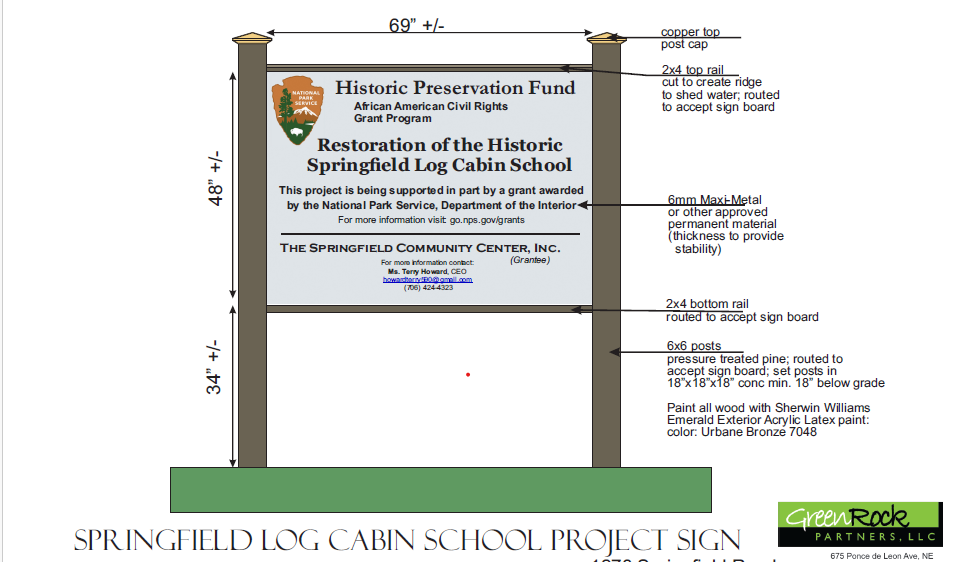
The Springfield community, located near Union Point in Taliaferro County, Georgia, stands as a powerful example of what Black families built when they were given even the smallest opportunity. African American property owners in the community cut logs from their own land to construct the Springfield Log Cabin School around 1935 — the first purpose-built school for Black students in the area. Following school consolidation in 1955, the building became a community center, In 1965, it served as a Freedom School supported by the Southern Christian Leadership Conference, where students were trained in activism and participated in demonstrations challenging school segregation. These efforts contributed to landmark legal cases, including Turner v. Goolsby and Turner v. Fouche. Today, the Springfield Community Center, Inc. — led by descendants of the original trustees, landowners, and students — continues the work of preservation and remembrance, ensuring that the stories of people like Rev. Joseph Thomas Dorsey are not lost to time. In 2025, the Center was awarded a $750,000 African American Civil Rights grant from the National Park Service to stabilize the historic log cabin school — a testament to the enduring significance of this community's heritage.
Archival Notes
Source Attribution Based on a 1916 biographical interview given by Rev. Joseph Thomas Dorsey to J.P. Stone. Modernized and compiled by the Springfield Community Center, Inc., Union Point, Georgia. |
Vital Records
Full Name | Rev. Joseph Thomas Dorsey |
Birth | October 27, 1877 — Warren County, Georgia |
Death | March 30, 1949 — Atlanta, Fulton County, Georgia |
Age at Death | 71 years |
Burial | Lincoln Cemetery, Atlanta, Fulton County, Georgia |
Related Archival Materials
● Restored portrait photograph of Rev. Joseph Thomas Dorsey (held in the Springfield Community Center archive)
● Modernized interview transcript — the 1916 biographical interview, prepared in accessible contemporary language while preserving Rev. Dorsey's original voice and meaning
● Original 1916 interview text — as recorded by J.P. Stone
● Catalogue of Atlanta Baptist College, 1911–1912 — Rev. Dorsey's enrollment confirmed. Available via the Digital Public Library of America and HathiTrust Digital Library.
● Auburn Avenue Research Library — Additional archival materials related to Atlanta Baptist College are preserved at the Auburn Avenue Research Library on African American Culture and History, Atlanta, Georgia.
Descendants of the original trustees, landowners, and students of the school lead Springfield Community Center, Inc. |
PREPARED FOR THE SPRINGFIELD COMMUNITY ARCHIVE
Springfield Community Center, Inc.
Union Point, Georgia
2026
Comments